
Campaign date: January 16, 2650
Primary setting: Freewheeling, a rough independent port on Tomin Kora
Campaign promise: Staff provides pressures. Players decide what changes.
Recently, Freewheeling survived a siege, an assault by the Parallax, and the arrival of an ancient fleet that could have destroyed everyone involved.
Then the truth got out.
Authenticated records exposed generations of secret transfers, prison programs, covert payments, and efforts to turn living people into recoverable property. House Veyl collapsed. The Parallax withdrew. The ancient Witness fleet departed. Mara Venn, the woman at the center of the crisis, left Tomin Kora aboard the damaged Small Apology.
Freewheeling remains.
Its dome is patched. Its port is open. Its people are angry, frightened, opportunistic, exhausted, and newly aware that distant institutions have been using their home as a marketplace, hiding place, and laboratory. Abandoned assets wait behind disputed seals. Survivors are deciding what to reveal. Creditors, salvagers, officials, refugees, investigators, and agents are arriving with incompatible claims.
Tomin Kora is not waiting for another hero to decide what happens next. That’s the work of the people who stay.
The setting in one minute
- Tomin Kora is a hard Fringe world whose best-known settlement is Freewheeling.
- Freewheeling is a port community beneath a life-supporting dome. Ships, cargo, contracts, repairs, and favors keep it alive.
- The King’s Peace protects basic life and independent commerce, but Freewheeling has no conventional government capable of solving every problem.
- Houses control capital and major infrastructure. Guilds and cooperatives control labor, expertise, and access. Independent groups fill the gaps.
- The Audit exposed institutional crimes connected to House Veyl and the Parallax. It did not expose every victim’s private history.
- Continuity notices now give some people a choice about records connected to earlier versions, copies, recoveries, or reconstructions of themselves. No character is required to receive one.
- House Veyl is gone as a functioning House, but its property, contracts, former workers, creditors, and victims remain.
- The Parallax is wounded, not defeated. Its agents, believers, defectors, and enemies all have reasons to come to Freewheeling.
- Mara Venn is off-world. She caused the present instability, but she is not the campaign’s quest-giver.
- Player characters drive the setting. Major developments occur because characters investigate, organize, negotiate, build, expose, protect, steal, or take sides.
Tomin Kora and Freewheeling
Tomin Kora sits on the edge of the Tomin Nebula, on the Fringe, where authority is distant, survival is practical, and every promise eventually meets a repair bill.
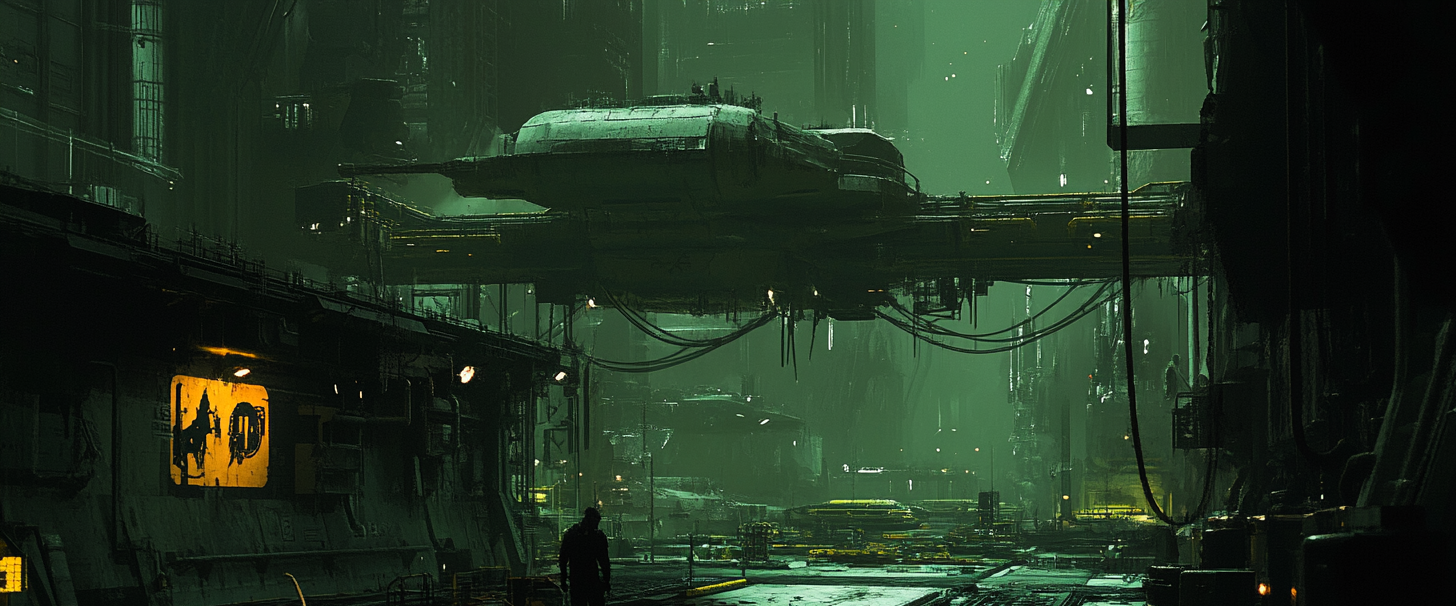
Most newcomers encounter the world through Freewheeling. The port is a pressurized knot of landing pads, repair berths, market corridors, utility shafts, residences, workshops, offices, shrines, bars, and improvised extensions. Beyond its protected spaces lie the Red Scarps, where weather, exposed ground, old machinery, and wreckage make travel dangerous and salvage tempting.
Freewheeling is neither a shining capital nor a lawless ruin. It is a functioning community held together by negotiated obligations. Air must circulate. Water must be reclaimed. Ships must unload. Workers must be paid. Contracts must be witnessed. The injured must go somewhere. Disputes must end before they damage the port everyone depends upon.
That necessity creates cooperation, but not equality. A person who controls a condenser, a docking tug, a cargo bond, or a replacement seal has power. So does a person who knows where the old conduits run, which captain honors a debt, or which claim was signed under coercion.
Freewheeling respects competence, memory, and nerve. It distrusts anyone who arrives with a perfect plan for other people.
What the King’s Peace means
The King’s Peace is Freewheeling’s central civic bargain. It is less a complete legal code than a boundary around shared survival and trade.
Under the Peace, residents and visitors are expected to refrain from conduct that endangers the settlement, destroys essential infrastructure, or makes independent commerce impossible. Violence, fraud, sabotage, and coercion matter most when they threaten more than the immediate participants.
The Majordomo’s Office interprets and enforces the Peace on behalf of Lord Fagin. Majordomo Abernathy is its public face. The office is not a conventional police department, and it cannot investigate every theft, settle every debt, or make every victim whole. It intervenes when a conflict threatens life, the port, or the continued independence of Freewheeling.
This leaves a great deal to Houses, guild tribunals, contract arbiters, mediators, hired investigators, mutual-aid groups, and the people directly involved. Whether that is freedom, neglect, or both depends on whom you ask.
What happened on Jan. 2
Freewheeling’s recent crisis can’t be reduced to one battle.
House Veyl forces besieged the settlement. The Parallax launched its own assault. An ancient Witness fleet arrived, drawn by technologies and identities rooted in a much older history. Freewheeling became the meeting point for incompatible powers, each claiming authority over people, records, or systems found there.
Mara Venn used the Living Ledger to release authenticated institutional records. Those records established chains of command, transfers, payments, prison programs, and deliberate attempts to classify people as assets that could be stored, copied, restored, or owned.
The release became known locally as the Audit.
The Audit did not indiscriminately publish everyone’s personal history. An Individual Consent Protocol protected personal continuity records. Each affected person retained the right to review, restore, seal, reject, or postpone a decision about their own record. No government, House, relative, creditor, or self-appointed protector was permitted to answer for them.
House Veyl couldn’t survive the disclosure. Its command structure broke, its credibility vanished, and its remaining personnel scattered, surrendered, or tried to disappear. Its offices, ships, accounts, and contracts are now contested.
The Parallax withdrew from Tomin Kora, politically damaged but still powerful. The Witnesses departed. Mara left aboard the Small Apology with Captain Jorra Kel, Kirra Greywake, and Sister Calis Sorelli. She took the Living Ledger with her.
Orennius Jask remains at Mercy House. He restored his own name privately and authorized public disclosure of the crimes committed against him. Sela Venn ended her active simulated personality, leaving her testimony and continuity preserved rather than continuing as a separate active person.
Freewheeling survived, but survival did not resolve ownership, responsibility, restitution, or trust.
The Audit and personal continuity
The most important rule is simple:
A person’s continuity is theirs to confront, define, or refuse.
A continuity notice indicates that authenticated material may exist concerning an earlier identity, stored cognition, copy, reconstruction, transfer, or related institutional record. Receiving a notice does not tell a person what choice to make, and it does not grant anyone else a claim upon them.
An affected person may:
- Review the record without immediately accepting its conclusions.
- Restore some protected material or acknowledge a prior continuity.
- Seal the record and preserve it from outside access.
- Reject the record or any claim that it defines the present person.
- Postpone the decision until they are ready.
These choices are not a morality test. A person who restores is not automatically more authentic. A person who seals is not hiding a crime. A person who rejects a record is not necessarily denying the truth. The question is one of consent, identity, and consequence.
Most characters do not need a continuity notice. It is an optional story tool, not the premise of every life on Tomin Kora.
Why the Audit still matters to everyone else
The institutional records affect ordinary life even when personal continuity does not.
A cargo carrier may learn that its former owner transported prisoners. A mechanic may discover that the equipment keeping a neighborhood alive was purchased through a Veyl front. A creditor may hold a valid-looking contract signed under coercion. A former Parallax officer may possess evidence that could convict a superior. A family may seek restitution from property now claimed by salvage crews.
The truth is available. Justice remains contested.
Who holds power
No single faction runs Freewheeling. Power overlaps, and every source of authority has limits.
The Stellar Consortium
The Stellar Consortium is one of the major interstellar powers beyond Tomin Kora. It links governments, corporations, banks, insurers, universities, relief organizations, intelligence services, security interests, and other institutions through trade, law, and mutual advantage.
It is not a single corporation and does not speak with one voice. A Consortium relief mission, commercial lender, diplomatic office, and intelligence service may all arrive under the same broad banner while pursuing different goals. They may cooperate, compete, conceal information from one another, or argue over what their shared principles actually require.
The Consortium often presents itself as a rules-based alternative to conquest and authoritarian rule. That distinction matters, especially beside the Parallax. Consortium institutions can deliver medicine, technical expertise, investment, secure shipping, legal recognition, and access to markets that Freewheeling genuinely needs.
They can also turn dependency into influence.
Consortium power usually arrives through paperwork, credit, standards, access, and enforceable agreements rather than occupation. A reconstruction loan can decide who controls a utility. An insurance requirement can determine which ships use the port. A relief contract can favor outside suppliers over local workers. Recognition of a claim can make a disputed Veyl facility saleable before its victims receive a hearing.
After the Audit, Consortium interests are converging on Tomin Kora for several reasons:
- Humanitarian relief: Mercy House is overwhelmed, residents are displaced, and damaged infrastructure still threatens lives.
- Reconstruction: Freewheeling needs equipment, expertise, shipping capacity, and credit.
- Commercial opportunity: Veyl assets, damaged ships, distressed businesses, and uncertain claims may be acquired cheaply.
- Legal precedent: Decisions about coerced contracts, continuity, restitution, and ownership could affect Consortium institutions elsewhere.
- Intelligence: The Audit exposed Parallax operations, command relationships, routes, personnel, and technologies that many agencies want to understand.
- Strategic containment: The Consortium does not want the Parallax to recover sensitive evidence, recruit exposed personnel, or regain exclusive control of what happened here.
The Consortium recognizes Lord Fagin’s King’s Peace as the practical framework governing Freewheeling. Recognition does not mean that every Consortium institution agrees on its legitimacy, scope, or future. Some representatives want a stable independent trading partner. Others would prefer a formal protectorate, a supervised recovery authority, or a port whose essential services depend on Consortium money.
Freewheeling’s residents are divided. Some regard Consortium involvement as the fastest credible path to recovery. Some see a distant power purchasing influence while the community is too damaged to negotiate fairly. Many hold both views at once.
Consortium characters need not be villains or secret agents. They might be sincere relief workers, commercial representatives, diplomats, claims specialists, investigators, contractors, creditors, security personnel, scientists, journalists, political idealists, or whistleblowers. The most useful concepts give the character both a reason to help Freewheeling and an obligation that complicates that help.
The central Consortium question is not whether it can contribute. It is whether Freewheeling can accept that contribution without surrendering the power to determine its own future.
The major Houses
Houses are commercial and political institutions built around property, expertise, patronage, and family or corporate identity. They are not noble houses in the ceremonial sense, although some cultivate that image. Joining a House may offer training, credit, protection, and influence, but it also creates obligations.
House Caldrin
House Caldrin works in air, water, power, pressure systems, and other infrastructure no one notices until it fails. Its saying, “Everyone breathes,” can sound like a promise or a reminder of leverage.
Caldrin technicians helped stabilize Freewheeling after the attack. The House now argues that long-term safety requires coordinated ownership and professional standards. Critics fear that emergency stewardship will become permanent control.
Inside Caldrin, one faction favors a civic trust that would place essential systems beyond ordinary House profit. Another believes only a strong, well-funded House can keep Freewheeling alive. Its attempts to acquire former Veyl assets have intensified the dispute.
House Nacari
House Nacari specializes in credit, cargo bonds, passage, escrow, insurance, claims, and arbitration. If trade depends on strangers trusting a promise, Nacari probably has an opinion about the wording.
The House operates prominently around Customs and Claims and the Hall of Weights. Its arbiters are now sorting through contracts touched by Veyl fronts, Parallax money, and coerced labor.
Nacari is divided over a dangerous question: Is a properly executed contract valid regardless of its surrounding circumstances, or does coercion poison the agreement from the beginning? The answer could transfer fortunes and decide whether hundreds of claims are debts, evidence, or stolen property.
House Orrox
House Orrox deals in salvage, metal, reconstruction, foundries, heavy equipment, and surface recovery. Its crews turn wreckage into hull plates, replacement supports, machine parts, and profit.
Orrox has the tools Freewheeling needs to rebuild and the appetite to acquire anything declared abandoned. Its crews often work beside independent reclaimers, but relations worsen whenever a promising wreck or Veyl facility receives competing salvage marks.
Some Orrox crews demand broader profit-sharing and local control. Central investors want tighter accounting, exclusive claims, and faster returns. Cinder Yard is both a workplace and an organizing ground for that struggle.
House Veyl
House Veyl has collapsed. It is not a hidden, intact organization waiting to resume normal operations, and it is not available as an ordinary player affiliation (although you can be a former member of that house).
Its consequences are everywhere. Former employees need work or protection. Victims want restitution. Creditors want repayment. Salvagers want abandoned equipment. Investigators want records. Other Houses want facilities, routes, and contracts.
Anyone claiming to speak for a restored House Veyl should expect intense scrutiny and resistance.
Guilds, cooperatives, and professional networks
Guilds hold power through labor, knowledge, reputation, and the ability to withhold their services.
Guild of Breath and Seal
Dome engineers, pressure inspectors, environmental technicians, and emergency crews belong to the Guild of Breath and Seal. They certify repairs and investigate failures in systems that can kill an entire district if neglected.
The Guild supports stronger safety standards but distrusts House Caldrin’s effort to dominate certification. Its members know which repairs are permanent, which are temporary, and which have simply been painted over.
Free Captains’ Table
The Free Captains’ Table is a network of independent ship captains who exchange route warnings, cargo opportunities, repair recommendations, crew openings, and emergency aid.
It is useful precisely because it is not a fleet. Some captains now want organized convoy protection against renewed Parallax pressure and opportunistic raiders. Others believe a formal defense pact would make the Table another authority waiting to happen.
Porters’ Cooperative
Loaders, cargo clerks, tug pilots, drone operators, and berth crews keep the port moving. The Porters’ Cooperative protects wages, assigns crews, and helps workers survive injuries or lost shifts.
Its members are debating whether handling disputed Veyl cargo makes them accomplices to theft, agents of restitution, or workers doing a necessary job. They also remember who kept working during the siege and who disappeared behind private security.
Reclaimers’ Guild
The Reclaimers’ Guild includes salvagers, appraisers, wreck cutters, recovery crews, and specialists who make dangerous places safe enough to strip.
Guild marks establish practical claims, but they do not settle every question of ownership. A sealed Veyl warehouse might be abandoned property, evidence, stolen goods, or a grave. The Reclaimers need rules that allow work without making them the final judges of the past.
Factors’ Exchange
Brokers, notaries, cargo buyers, currency traders, and contract specialists use the Factors’ Exchange to make deals legible and enforceable.
The Exchange is becoming a battlefield over commercial consent. Its members must decide when a signature proves agreement, when surrounding evidence proves coercion, and who bears the cost when old bargains are voided.
Independent organizations and civic currents
Mercy House
Mercy House is a refuge, clinic, archive, and place of witness. It shelters people who have nowhere safer to go, preserves testimony, assists recipients of continuity notices, and helps survivors navigate institutions that once treated them as property.
Mother Mercy provides moral authority, but Mercy House is not a government or a court. It needs medics, counselors, guards, investigators, archivists, couriers, donors, and ordinary volunteers. It also needs boundaries. Every powerful faction wants access to someone or something under its roof.
Orennius Jask remains there as a survivor and public witness. He is not a universal spokesperson for everyone harmed by Veyl or the Parallax.
The Majordomo’s Office
Majordomo Abernathy represents Lord Fagin and maintains the King’s Peace. The office can arbitrate urgent conflicts, mobilize limited security, and act when a threat endangers Freewheeling as a whole.
Some residents want Abernathy to build a stronger civic administration. Others warn that emergency powers have a habit of surviving emergencies. The office must preserve order without becoming the next master Freewheeling rejects.
Ashfall Mutual
Ashfall Mutual is a loose network of displaced residents, cooks, couriers, repair crews, hosts, and donors. It finds temporary beds, shares supplies, posts work needs, and helps people whose homes or livelihoods were damaged during the attack.
It has no permanent leader and no settled future. It could become a durable mutual-aid institution, a political movement, a neighborhood network, or a short-lived response to crisis. Player characters may shape that outcome.
Audit Claimants
“Audit Claimants” is a broad label for people comparing evidence, seeking missing relatives, pursuing compensation, demanding trials, or identifying property connected to institutional crimes.
They are not one organization. Some want public proceedings. Some want private settlements. Some want revenge. Some want nothing more than an accurate record and the right to be left alone.
The Sealed
The Sealed is an outside name applied to people who sealed, rejected, destroyed access to, or declined to discuss continuity material.
They have no shared ideology. Treating them as a conspiracy or a suspicious class violates the very principle the consent protocol was created to protect.
Quiet Faithful
The Quiet Faithful are Parallax expatriates and believers associated with Nalia’s faith and traditions. The label includes loyalists, reformers, penitents, doubters, and people who simply do not want their culture reduced to the crimes of the state.
They disagree fiercely over Vox, the Order Council, obedience, collective guilt, and what faith should demand after the Audit. The community’s leadership and direction are open to play.
No New Masters
“No New Masters” appears in graffiti, broadsheets, arguments, and public meetings. It rejects renewed control by the Parallax, the Consortium, the Houses, or an expanded local regime.
It has no fixed leadership or agreed program. For one person, the phrase means neighborhood democracy. For another, it means armed independence. For a third, it is a useful slogan painted over evidence of ordinary criminal ambition.
Places to know
These locations form the campaign’s shared geography. They are broad enough to contain player-created businesses, homes, offices, alleys, and gathering places.
High Approach
Incoming vessels encounter Freewheeling through High Approach. The Last Light Beacon provides navigation and carries the emotional weight of a promise: if it’s transmitting, the port still lives.
Traffic control disputes, damaged ships, suspicious arrivals, rescue operations, and first contact with returning travelers all fit here.
Freewheeling Port Concourse
The Concourse is the public threshold of the settlement, crowded with travelers, crew seekers, porters, inspectors, claimants, and people waiting for someone who may not arrive.
The Claimants’ Steps have become an informal gathering place for notices, protests, testimony, and competing demands after the Audit.
Pad Twelve and Berth Row
Pad Twelve and the surrounding berths handle cargo, repairs, refueling, crew transfers, and ships that need more work than their captains can afford.
The Scorchline still marks damage from the attack. Cinder Yard, nearby, holds metal stock, salvage, heavy equipment, and Orrox operations.
Customs and Claims
Permits, cargo declarations, passage records, liens, asylum requests, salvage notices, and commercial disputes converge here.
The Hall of Weights houses formal arbitration and witnessed agreements. Locker Nine has a reputation as a place where a small sealed item can generate a very large problem.
Market Spine
The Market Spine is Freewheeling’s commercial and social artery. Permanent shops, temporary stalls, food counters, service desks, performers, brokers, and quiet opportunists compete for attention.
The Empty Exchange is a flexible meeting and trading space whose name outlived several attempts to fill it permanently. Nine Lanterns is a familiar landmark for arranged meetings, public notices, and watching the crowd.
The Motherlode
The Motherlode is a tavern, hiring hall, rumor exchange, and neutral ground until someone proves otherwise. Captains find crew, workers find shifts, strangers find trouble, and old acquaintances learn whether absence improved their relationship.
The Back Table is traditionally used for conversations that are private in intention, if not always in fact.
Mercy House
Mercy House combines refuge, clinic, archive, and sanctuary. Its Names Wall records people who must not be reduced to case numbers. Its Quiet Room provides space for private decisions and difficult conversations. Its Vault holds protected materials whose existence attracts far too much interest.
Lower Lift
The Lower Lift connects public Freewheeling to utility levels, maintenance access, labor routes, and older construction. The Third-Breath Landing is a common muster point for repair crews and anyone waiting for clearance to go deeper.
Work scenes, infrastructure emergencies, covert movement, and disputes over who controls access fit naturally here.
Old Fagin Works
The Old Fagin Works contain aging infrastructure, abandoned industrial spaces, workshops, and areas whose original purpose is now disputed.
The First Court serves as an irregular civic gathering place. Public arguments held there can become policy, theater, or both.
Eastern Maintenance Lock
The Eastern Maintenance Lock provides controlled access between the settlement’s protected systems and exterior repair routes. It is valuable to engineers, couriers, salvagers, and smugglers.
Apology Gap is a nearby breach and repair zone associated with the recent crisis. Its security and ownership remain sensitive.
Red Scarps
The Red Scarps lie beyond Freewheeling’s ordinary shelter dome. Surface crews face harsh conditions, unreliable machinery, poor visibility, and the consequences of small mistakes.
Lightning Glass marks terrain altered by electrical storms. Shipbreakers’ Reach contains wreckage and disputed salvage rich enough to tempt crews past good judgment.
Life in Freewheeling
Life in Freewheeling is built around maintenance. Residents notice the sound of ventilation, the taste of reclaimed water, the timing of cargo lifts, and the silence that follows a machine stopping unexpectedly. Repair work is respected because everyone understands what failure costs.
The port runs on a mixture of formal contracts and remembered favors. Written agreements matter, but so do reputation, witnesses, and whether a person remained reliable when enforcement was impossible. After the Audit, more residents ask who benefited from an agreement and whether everyone involved could meaningfully refuse it.
Work and social life overlap. A tavern may double as a hiring hall. A guild meeting may become an emergency response. A cargo delay may strand a neighborhood’s medicine, a captain’s payroll, and a claimant’s evidence in the same locked container.
Privacy is valuable and often difficult. Freewheeling culture respects the right to keep one’s past sealed, but the port also thrives on rumor. The conflict between those values is part of daily life.
Newcomers are usually judged by three questions:
- What can you do?
- Who will vouch for you?
- What happens when your problem becomes everyone else’s problem?
The four current pressures
These are not scores that change on their own. They are a way to understand what the community is struggling with. They move when player characters act.
Recovery
Can Freewheeling repair its infrastructure, reopen damaged livelihoods, care for survivors, and prepare for the next emergency?
Recovery improves through repairs, supply runs, mutual aid, successful business, medical work, and practical organization. It worsens through sabotage, exploitation, failed projects, shortages, and preventable conflict.
Consent
Will Freewheeling honor people’s choices about identity, testimony, contracts, and personal records when those choices become inconvenient?
Consent improves when characters protect privacy, expose coercion, create fair procedures, and accept decisions they dislike. It worsens when people are pressured, exposed, treated as evidence, or defined by institutions without meaningful choice.
Sovereignty
Who gets to make decisions for Freewheeling, and what keeps that authority accountable?
Sovereignty grows through credible local institutions, alliances, public participation, and successful resistance to outside control. It weakens through dependency, factional capture, secret rule, and the arrival of powers Freewheeling cannot refuse.
Heat
How much dangerous attention is focused on Tomin Kora?
Heat rises when hidden facilities are exposed, outside agents are provoked, valuable technology surfaces, or local conflicts threaten larger interests. It falls when characters negotiate, misdirect, contain threats, or make Freewheeling too useful to attack.
Low Heat is not always good. Sometimes attention brings allies, trade, witnesses, and leverage. High Heat is not always disastrous. Sometimes it means Freewheeling has become impossible to ignore.
Characters who belong here
Freewheeling supports characters who have something useful to do and a reason to become entangled with other people.
Strong concepts include:
- A local resident, dome technician, utility worker, porter, or neighborhood organizer.
- An independent captain, pilot, navigator, shiphand, or stranded passenger.
- A trader, broker, smuggler, courier, factor, or contract specialist.
- A mechanic, salvager, engineer, appraiser, or surface recovery worker.
- A medic, counselor, archivist, investigator, or Mercy House volunteer.
- A reporter, advocate, attorney, mediator, or keeper of inconvenient records.
- A former Parallax officer, witness, veteran, expatriate, believer, dissenter, or defector.
- A House employee, guild member, creditor, contractor, or ambitious independent.
- A security specialist, bounty hunter, bodyguard, or person trying to leave that work behind.
- Someone seeking a missing person, disputed inheritance, stolen identity, unpaid debt, or chance to begin again.
Species, gender, origin, profession, and social status are open within the broader OtherSpace setting. A character need not understand the Audit in detail before arriving. Curiosity, employment, obligation, refuge, and bad timing are all sufficient reasons to enter play.
Six questions for every character
- Where were you during the January 2 attack?
- Did you receive a continuity notice? If not, how has the Audit affected you anyway?
- Why are you staying on Tomin Kora, or why have you just arrived?
- What skill, access, resource, or information can you offer other characters?
- Who wants something from you?
- What part of Freewheeling would you hate to see controlled by someone else?
If your character received a continuity notice, add one more question: Did they review, restore, seal, reject, or postpone it? That answer may change during play, but only with the player’s consent.
Create your Freewheeling character
Once you have a concept, use the Create a Freewheeling Character form on the OtherSpace website.
The form walks you through the following information:
- Character name: Enter the public name other players will see.
- Portrait: You may upload an optional character image. The current upload limit is 2 MB.
- Pronouns and gender: Use the language that best describes your character.
- Species: Choose Human, Demarian, Castori, Timonae, Odarite, Zangali, or the staff-assisted option for another species.
- Character concept: Briefly explain who the character is, what they do, and why they are part of Freewheeling.
- Physical description: Describe what other characters can perceive when they meet yours.
- Story hook: Give other players something they can approach your character about. A job, need, obligation, rumor, resource, or unresolved problem works well.
- Private background: Share any history or secrets that staff may need to understand but that should not appear as public character knowledge.
- Review and submit: Check your answers, then send the completed form into the site’s character system.
You do not need to write a complete biography before playing. A useful starting character has a reason to be on Tomin Kora, something to offer other characters, and at least one situation that could pull them into a scene. Their history can deepen through play.
Continuity material is optional. You may create a character with no continuity notice or connection to the Audit.
After submitting the form, join the OtherSpace Discord community. Introduce yourself in #freewheeling-ooc, use #freewheeling-looking-for-play to find scene partners, and watch #freewheeling-scenes for open scenes. If you have questions about a species, concept, private background, or form submission, contact staff through Discord.
Starting a story
You do not need permission to begin with an ordinary problem. Ordinary problems become political when enough people care about them.
Possible first scenes include:
- A disputed Veyl asset is offered at auction while a claimant insists it was stolen.
- A damaged ship arrives with evidence, injured crew, and no captain willing to explain the route it took.
- Mercy House needs escorts for a person whose identity must remain sealed.
- A repair crew discovers that a temporary dome patch is failing earlier than expected.
- Porters refuse to move a cargo container until someone determines whether it contains property or evidence.
- A Parallax officer asks for neutral protection under the King’s Peace and offers testimony in exchange.
- Two continuity notices appear connected to the same still-active facility, office, or transport route.
- A salvage mark at Shipbreakers’ Reach overlaps a House claim and a family’s memorial site.
- A public meeting at First Court asks whether essential infrastructure should become a civic trust.
- Someone paints NO NEW MASTERS across a sealed office hours before its records disappear.
The best opening problems involve at least two reasonable needs that cannot both be satisfied easily.
How play works
Public roleplay takes place in the Freewheeling scenes forum on Discord. Each forum post is one scene. Location, availability, and pacing tags help other players find it. Scenes may be played close to real time or asynchronously.
The WordPress site holds durable campaign information, character sheets, setting lore, and completed-scene records. Discord handles conversation, matchmaking, and active scenes.
Players may create minor contacts, businesses, residences, work crews, customs, and local details that support their stories. Coordinate before creating facts that would affect another character, settle a major faction question, introduce overwhelming technology, or resolve a campaign-wide threat.
Staff does not advance major events merely because time passed off-screen. Staff introduces pressures, consequences, and opportunities. The community changes when player characters engage with them.
What remains open
The primer establishes a common starting point, not a complete encyclopedia.
The following are deliberately available for player development:
- New shops, services, bars, workshops, shrines, and neighborhood gathering places.
- Minor Houses, family enterprises, crews, and professional associations.
- Leaders and internal movements within Ashfall Mutual, the Quiet Faithful, and No New Masters.
- New interpretations, rivalries, and reform movements within the established Houses and guilds.
- Personal consequences of the Audit that do not override another character’s history.
- Additional landmarks within the established Freewheeling locations.
- Customs, slang, celebrations, food, fashion, art, and entertainment grounded in the people who live here.
When adding lore, ask three questions:
- Does this give other players something to engage with?
- Does it leave room for other characters to matter?
- Does it create choices instead of declaring the outcome?
If the answers are yes, it probably belongs in Freewheeling.
Boundaries of the opening campaign
- Mara Venn and the Small Apology are off-world.
- The Living Ledger is not available as a local answer machine or adventure reward.
- The Witness fleet is gone and should not be treated as nearby rescue or firepower.
- House Veyl has collapsed and should not quietly return as an intact institution.
- The Parallax remains a major authoritarian power, even after its political defeat at Tomin Kora.
- Continuity stories are optional. Not every mystery, job, relationship, or crime connects to them.
- No player character may decide another person’s continuity, consent, memories, or identity for them.
- Freewheeling can improve, fracture, organize, or compromise. None of those outcomes is predetermined.
Quick glossary
The Audit: Mara Venn’s release of authenticated institutional records revealing crimes associated with House Veyl, the Parallax, and related programs.
Continuity: The relationship between a present person and prior, stored, copied, reconstructed, or transferred versions and records of that person.
Continuity notice: A private notice that protected continuity material may exist for a person. It creates choices, not obligations.
Individual Consent Protocol: The rule that only the affected person may decide whether to review, restore, seal, reject, or postpone their personal continuity record.
Living Ledger: The system Mara used to authenticate the Audit and protect individual choice. It left Tomin Kora with her.
The Parallax: An authoritarian interstellar power governed by Vox and the Order Council. It withdrew from Tomin Kora but did not collapse.
Vox: The central sovereign authority of the Parallax.
The Fringe: Regions where distant governments and institutions possess influence but cannot reliably provide everyday order or protection.
The King’s Peace: Freewheeling’s civic bargain protecting essential life, infrastructure, and independent commerce.
House: A large commercial and political institution organized around capital, expertise, property, patronage, and shared identity.
Mercy House: Freewheeling’s refuge, clinic, archive, and center for protected testimony and continuity assistance.
The question at the center of play
The truth got out. That was the beginning, not the ending.
Now everyone on Tomin Kora must decide what truth requires of them, what consent costs when it protects an inconvenient choice, and how a community remains independent without abandoning the people who keep it alive.
Who gets to shape Freewheeling after the Audit: the people living with the truth, or the institutions trying to contain it?